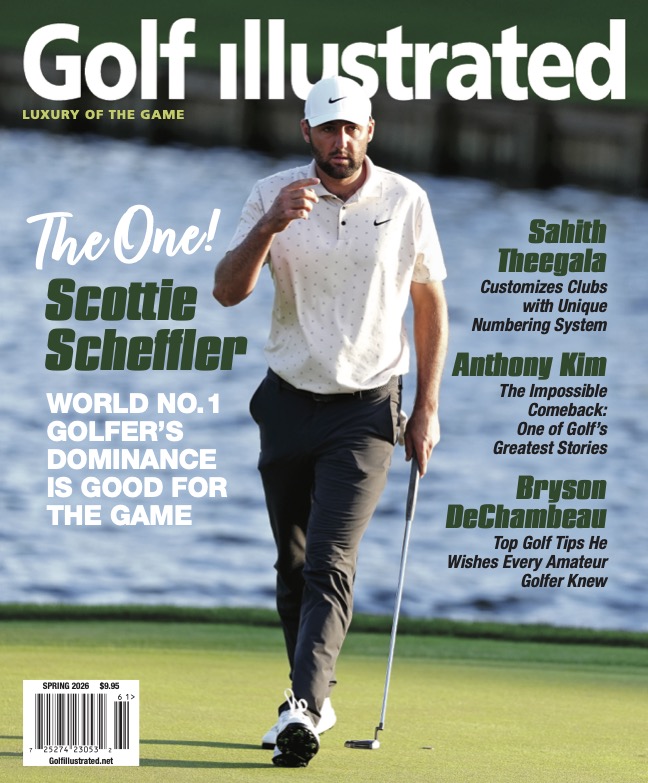
Every generation of sports finds its axis — the singular, unmistakable force around which everything else orbits. For two decades, professional golf’s axis was Tiger Woods, a player so transformative in his dominance that the sport was divided cleanly into two eras: the years with him, and the uncertain years without. For nearly a decade following Woods’ decline, golf searched for its center. Brilliant players emerged. Major championships were shared across a dozen names. The leaderboard was democratic, unpredictable, and occasionally thrilling. But something was missing.
Then came Scottie Scheffler.
And now, after four years of an ascent so methodical and complete that it has begun to reshape not just the tour’s record books but the very culture of professional golf, the most pressing and energizing question in the sport is not whether Scheffler is dominant. He plainly, undeniably is. The question worth asking — and the one that deserves a far more affirmative answer than it typically receives — is whether that dominance is good for golf.
The answer, examined carefully, is yes. Unambiguously, historically yes.
The Numbers Demand Respect
To discuss Scheffler’s dominance requires a brief accounting, because the numbers are not merely impressive — they are staggering in their breadth and consistency. Since February 2022, the 29-year-old Texan has won 20 PGA Tour events, four major championships, an Olympic gold medal, and multiple Hero World Challenge titles. In 2025 alone, he captured six official PGA Tour victories including the PGA Championship and The Open Championship — becoming the first golfer since Seve Ballesteros to win his first three majors by three shots or more. He joined Jack Nicklaus and Tiger Woods as the only golfers since 1950 to win at least 15 PGA Tour tournaments before the age of 29.
He has held the World No. 1 ranking for more than 175 weeks and counting. He led an almost incomprehensible 28 different statistical categories on the PGA Tour in 2025, including strokes gained total, off the tee, tee-to-green, and approach. He earned $27.6 million in official money, topping the Tour’s financial list for the year. He has won the Jack Nicklaus Award — the PGA Tour’s Player of the Year honor — four consecutive times, a feat matched only by Tiger Woods himself.
And he opened the 2026 season by winning his 20th Tour event at The American Express in January, becoming only the third player since 1950, alongside Nicklaus and Woods, to reach 20 wins before the age of 30.
The numbers do not lie, and they do not embellish. Scottie Scheffler is, by every measurable standard, the most dominant golfer on the planet.
The Case Against — and Why It Falls Short
The skeptics have made their argument, and it deserves a fair hearing. The concern, reduced to its plainest form, is this: when one player wins too often by too many strokes, the drama dissipates, the casual viewer changes the channel, and the sport suffers. The Tiger Woods parallel cuts both ways — yes, his dominance generated enormous interest, but that was partly because Woods brought a volcanic charisma and psychological ferocity to the game that made his victories feel like events. Scheffler, by contrast, wins with a kind of serene, almost algorithmic precision that some viewers find difficult to narrativize. He has himself described golf as something that does not fill the deepest wants and desires of his heart, a philosophy that, while admirable in its honesty, is not the stuff of traditional sports mythology.
There is data that partially supports the concern. The final round of the 2025 PGA Championship, in which Scheffler cruised to a five-stroke victory at Quail Hollow Club, drew 4.76 million viewers on CBS — a four percent dip from the previous year’s more dramatic finish. Television executives and sports media analysts were quick to note the correlation between blowout victories and reduced viewership. Former Tour player Stewart Cink articulated the sentiment that circulates in many golf conversations: Scheffler may be incredible, but he is not, at least not yet, the kind of personality people specifically turn on the television to watch in the way they once did for Woods.
These are legitimate observations. But they tell only part of the story, and not the most important part.
The Evidence in Favor
Zoom out from any single tournament and the broader picture looks markedly different. CBS Golf delivered nearly three million average viewers across its golf windows in 2025, a jump that essentially erased the viewership decline of 2024 and represented one of the most significant single-year rebounds in the sport’s television history. Fourteen of 19 final-round PGA Tour telecasts on CBS posted year-over-year ratings gains, many of them by double digits. The PGA Tour as a whole saw its viewership increase ten percent in 2025 compared to the previous year. Golf Channel live coverage was up eight percent among total viewers.
Those numbers tell a story about a sport that is growing, not shrinking, under Scheffler’s reign. And when his victories have generated genuine suspense — or simply the spectacle of watching someone perform at a rarefied level — the ratings have responded accordingly. The 2025 Open Championship at Royal Portrush, where Scheffler built a lead that at one point reached seven shots, drew more than four million average viewers for NBC’s final round — a jump of over 600,000 from the previous year’s far more tightly contested championship. Sky Sports reported its most-watched Open coverage in history across the four days. The data offered a counterintuitive finding: fans will watch a blowout if they sense they are witnessing history.
And that sense, week by week and month by month, is growing stronger.
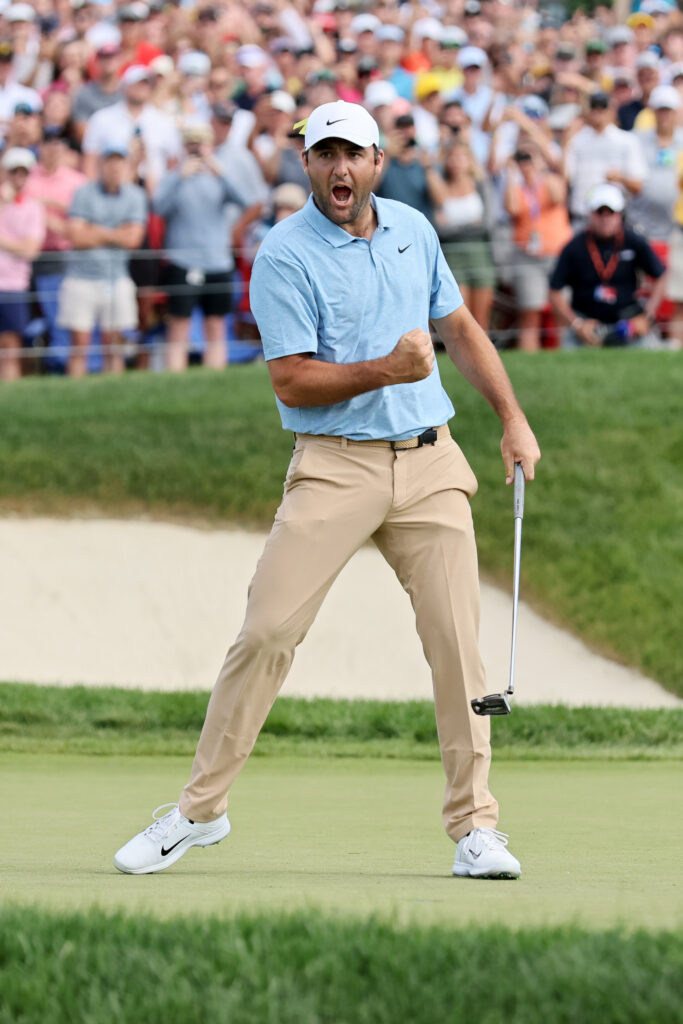
The Gravitational Pull of Greatness
Perhaps the most compelling argument for Scheffler’s dominance being good for golf has nothing to do with television ratings at all. It is about what his presence does to the competitors around him — and by extension, to the standard of the game itself.
Rory McIlroy, who completed the career grand slam at the 2025 Masters in one of the most emotionally charged victories in the tournament’s modern history, has openly cited Scheffler as the model he is attempting to replicate. After a stellar third-round performance at the AT&T Pebble Beach Pro-Am this January, McIlroy explained his approach simply: “Just really try to limit the mistakes and play smart golf and be a little more like Scottie Scheffler.” It is a remarkable statement from one of the finest golfers of his own era — an admission that there is a new template, and Scheffler wrote it.
The influence extends to the youngest generation. When then-amateur Luke Clanton was asked at the 2026 WM Phoenix Open why he loved the game of golf, his answer wandered quickly toward Scheffler: “Golf is not my identity. I learned that one from Scottie.” A 20-year-old amateur was citing the world’s best player not just as a technical benchmark but as a philosophical one.
This is what generational dominance looks like in its most constructive form. Woods shaped golf because his intensity and work ethic became the target. Scheffler is shaping golf because his equanimity, his precision, and his philosophy of separating self-worth from scorecards have given the sport something it was missing in the post-Woods era: a north star. A guiding principle, both on the course and off it.
The Chase Is the Story
There is one more argument in favor of Scheffler’s dominance, and it may ultimately prove to be the most powerful. Every era of sporting greatness creates the most meaningful backdrop against which individual achievement is measured. Winning a PGA Tour event in 2026, with Scheffler in the field, means something different — and arguably more significant — than winning one in a period of genuine parity. Ask Chris Gotterup, who has already won twice in 2026 and done so by matching Scheffler shot for shot down the stretch in consecutive weeks. Ask Collin Morikawa, who broke a 28-month drought at Pebble Beach by surviving a final-round charge from the world’s No. 1. The presence of the standard bearer makes every victory richer.
Scheffler himself is just one major away from completing the career grand slam — the U.S. Open is the only title yet to be added to a mantle that already holds the Masters, PGA Championship, and The Open Championship. When he does contend at Pinehurst or Oakmont or wherever fate delivers the opportunity, the magnitude of that storyline will bring the full weight of the sport’s attention to bear. Sports fans love, above all else, the witnessing of history. Scheffler is in the process of making it, chapter by chapter, week by week.
The question is not whether his dominance is good for golf. The question is whether golf fully appreciates what it has. A once-in-a-generation talent who wins with poise, speaks with wisdom, carries himself with grace, and continues to elevate every golfer fortunate enough to compete against him.
That is not a problem for the game of golf. That is an era.